
Table of Contents
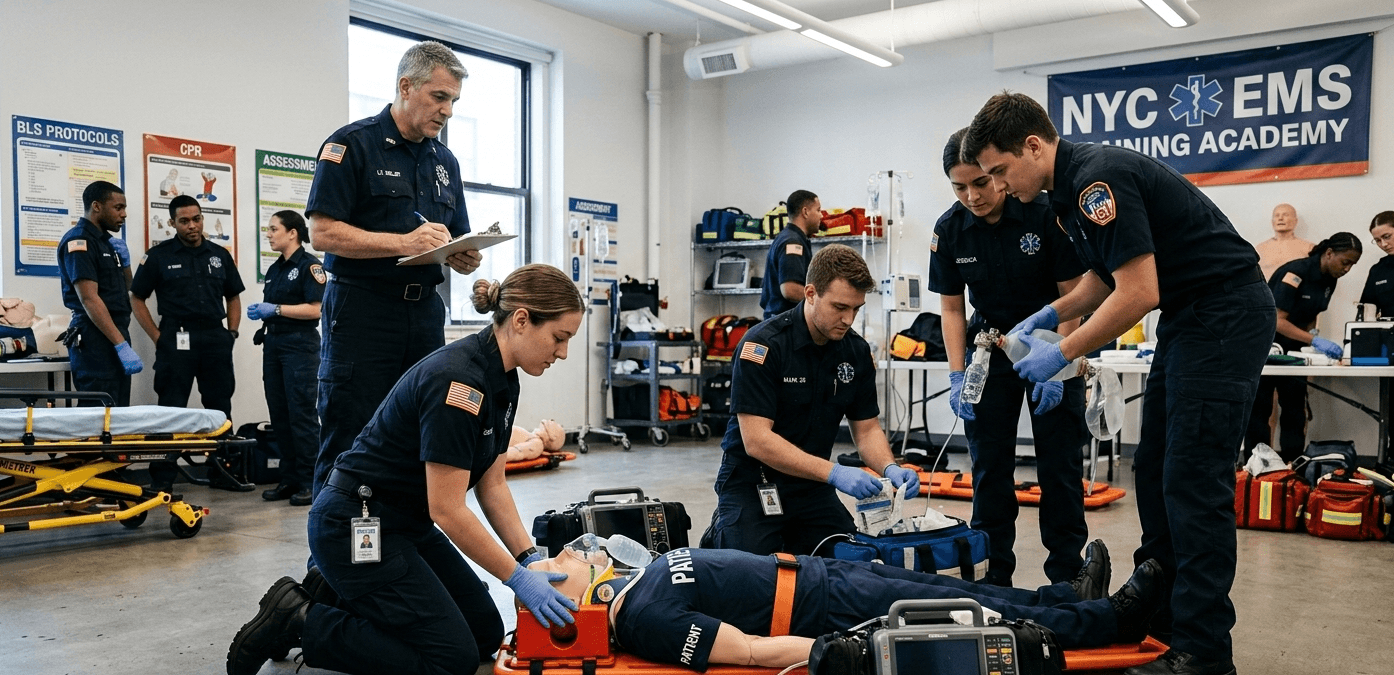
EMT Training in 2026
The United States needs more EMTs. Across the country, fire departments, ambulance services, and hospitals are competing for a shrinking pool of qualified emergency medical technicians. For the organizations running EMT training programs, that means more demand, more cohorts, and more operational complexity than ever before.
Whether you're launching a new EMT program from scratch or looking to tighten up an existing one, this guide covers the full picture: the regulatory requirements you must meet, the curriculum standards your program needs to follow, the operational challenges you'll face, and the practical strategies that successful programs use to fill seats, stay compliant, and produce graduates who pass the NREMT on their first attempt.
This is not a surface-level overview. It's a working reference for program directors, training coordinators, and EMS educators who are serious about running a program that works.
Understanding the EMS Education Landscape
EMS education in the United States is governed by a combination of federal guidelines, state-level regulation, and national credentialing standards. No single entity controls everything, which is part of what makes running a program complex.
Here's the framework at a glance:
- NHTSA (National Highway Traffic Safety Administration) develops and publishes the National EMS Education Standards that define the minimum competencies for each certification level.
- State EMS offices (typically housed within a Department of Health or Department of Public Safety) approve and regulate training programs operating within their borders.
- CoAEMSP (Committee on Accreditation of Educational Programs for the EMS Professions) provides voluntary programmatic accreditation for AEMT and Paramedic programs on behalf of CAAHEP.
- NREMT (National Registry of Emergency Medical Technicians) administers the national certification exams and maintains the registry of certified providers.
- NAEMSE (National Association of EMS Educators) supports EMS educators with professional development, instructor courses, and curriculum guidance.
For an EMT-Basic program specifically, the two non-negotiable requirements are state approval and alignment with the National EMS Education Standards. CoAEMSP accreditation is not required at the EMT level (more on this later), but state approval absolutely is.
The Four Levels of EMS Certification
Before diving into program operations, it helps to understand where EMT-Basic fits within the broader EMS certification structure. The National EMS Scope of Practice Model defines four levels, each building on the one before it:
Emergency Medical Responder (EMR) — The entry point. EMRs provide immediate life-saving care at the scene: CPR, bleeding control, and patient stabilization while waiting for an ambulance. Training is typically 40–80 hours.
Emergency Medical Technician (EMT) — The most common certification level in EMS and the backbone of most ambulance services. EMTs provide basic life support, administer certain medications (like epinephrine and albuterol), operate AEDs, and transport patients. Training typically runs 120–150 hours.
Advanced Emergency Medical Technician (AEMT) — Bridges the gap between EMT and Paramedic. AEMTs can establish IV lines, administer a wider range of medications, and perform advanced airway management. Training is 200–400 hours.
Paramedic — The highest level of prehospital care. Paramedics perform advanced cardiac life support, interpret EKGs, administer complex medications, and make critical decisions in high-pressure situations. Training requires 1,200–1,800 hours, including extensive clinical and field experience.
Most training programs start by offering EMT-Basic courses before expanding into AEMT or Paramedic programs. This guide focuses primarily on the EMT level, though much of the operational advice applies across all levels.
Getting State Approval for Your Program
You cannot legally operate an EMT training program without approval from your state's EMS regulatory authority. This is the first and most important step.
Who approves programs?
Every state has a designated agency responsible for EMS education oversight. In most cases, this falls under the state Department of Health or Department of Public Safety. Examples include:
- New York: Bureau of Emergency Medical Services (BEMS) within the Department of Health
- Texas: Department of State Health Services (DSHS), EMS and Trauma Systems Division
- Florida: Department of Health, Bureau of Emergency Medical Services
- California: Emergency Medical Services Authority (EMSA)
Your first action should be contacting your state's EMS office directly. Requirements vary significantly from state to state, and what applies in Texas may not apply in Oregon.
What states typically require
While specifics vary, most state approval applications require you to demonstrate:
- A qualified program director or course coordinator who holds the appropriate EMS instructor certification
- A designated medical director — a licensed physician (MD or DO) with training or experience in prehospital care
- Adequate facilities and equipment for classroom instruction, skills labs, and simulated patient scenarios
- A curriculum that meets or exceeds the National EMS Education Standards
- Clinical affiliation agreements with hospitals, ambulance services, or other healthcare facilities where students will complete clinical rotations
- A written sponsorship agreement between the program's key stakeholders (typically involving the chief executive, course medical director, and sponsor administrator)
How long does approval take?
Plan for 6–12 months from initial application to final approval, depending on your state. Some states require an on-site visit before granting approval. Others may have a review process that involves regional EMS councils before reaching the state office.
Don't wait until the last minute. Build your application package well in advance, and reach out to your state EMS office early in the process. Many states are willing to provide guidance on what they need to see in your application.
Meeting the National EMS Education Standards
The 2021 National EMS Education Standards, developed by NHTSA in partnership with NAEMSE, define the minimum competencies that every EMS graduate must demonstrate. These standards are the foundation of every state-approved EMS curriculum in the country.
What the standards cover
The standards define competencies across three domains:
- Cognitive (knowledge): What students must understand — anatomy, physiology, patient assessment, pharmacology, medical and trauma emergencies, and special populations.
- Psychomotor (skills): What students must be able to physically do — airway management, CPR, splinting, medication administration, spinal immobilization, etc.
- Affective (professional behavior): How students must conduct themselves — communication, ethical decision-making, teamwork, and patient advocacy.
An important nuance
The National EMS Education Standards are intentionally non-prescriptive about how programs deliver instruction. They define what students must be able to do, not how you teach it. This flexibility allows programs to use lecture, simulation, online modules, case-based learning, or any combination — as long as graduates meet the defined competencies.
That said, your state may have additional requirements on top of the national standards, including minimum hour requirements, specific clinical rotation mandates, or additional topics. Always cross-reference the national standards with your state's requirements.
Where to access the standards
The full 2021 National EMS Education Standards document is publicly available through NAEMSE and NHTSA's EMS.gov website. If you're developing or revising a curriculum, this is essential reading.
Accreditation: CoAEMSP, CAAHEP, and When It Matters
Accreditation is one of the most commonly misunderstood topics in EMS education. Here's what you need to know.
State approval vs. programmatic accreditation
These are two separate things:
- State approval is a regulatory requirement. You must have it to operate a training program in your state. Period.
- Programmatic accreditation through CoAEMSP/CAAHEP is a voluntary, third-party quality validation that demonstrates your program meets national accreditation standards.
When accreditation is required
For EMT-Basic programs: CoAEMSP accreditation is not required. State approval is sufficient.
For Paramedic programs: Accreditation matters significantly. The NREMT requires paramedic candidates to graduate from a CAAHEP-accredited program (or one holding a CoAEMSP Letter of Review) in order to sit for the national certification exam. If your graduates can't take the NREMT, they can't practice in most states. So for paramedic programs, accreditation is functionally mandatory.
For AEMT programs: As of January 2025, CoAEMSP began accepting applications for voluntary AEMT accreditation. It's not required, but it may become a differentiator for programs that want to demonstrate quality.
Should you pursue accreditation for your EMT program?
If you're only running EMT-Basic courses, accreditation isn't required, and the cost and administrative burden may not be justified. However, if you plan to expand into paramedic education, getting familiar with the accreditation process early will save you time later.
Structuring Your EMT Program
The structure of your EMT program — how many hours, what format, how long — will depend on your student population, your instructors' availability, and your state's minimum requirements.
Typical program formats
Most EMT programs fall into one of these formats:
Daytime intensive: 9–12 weeks, Monday through Friday. Best for students who can commit full-time. Often includes 6–8 hours of classroom and lab instruction per day.
Evening/weekend: 16–22 weeks, typically meeting 2–3 evenings per week and/or on weekends. Popular with working adults and career changers. This is often the format that fills the most seats.
Hybrid: A combination of online didactic instruction and in-person skills labs and clinical rotations. Gaining popularity, especially post-2020, though states vary in how much online instruction they allow.
Total hours
A typical EMT-Basic program requires approximately 150–280 total contact hours, broken down into:
- Classroom instruction: 120–200+ hours covering the cognitive curriculum
- Skills lab: Integrated throughout, typically 2–4 hours per week of hands-on practice
- Clinical rotations: 24–84 hours in hospital emergency departments, ambulance ride-alongs, and sometimes dispatch observation
Check your state's specific minimum hour requirements. Some states specify exact minimums; others defer to the National EMS Education Standards.
Core curriculum topics
Based on the National EMS Education Standards, your EMT curriculum should cover:
- Preparatory (EMS systems, workforce safety, medical/legal issues, communication, documentation)
- Anatomy and physiology
- Medical terminology
- Pathophysiology
- Life span development
- Public health
- Pharmacology
- Airway management, respiration, and artificial ventilation
- Patient assessment
- Medicine (respiratory, cardiovascular, neurological, gastrointestinal, endocrine, psychiatric, toxicology, and more)
- Shock and resuscitation
- Trauma (bleeding control, soft tissue injuries, musculoskeletal care, head and spinal injuries)
- Special patient populations (obstetrics, neonatal, pediatric, geriatric, patients with special challenges)
- EMS operations (transport, incident management, multiple casualty incidents, hazardous materials)
Instructor Requirements and Hiring
Finding and keeping good instructors is one of the biggest challenges in EMS education. Here's what you need to know about who's qualified to teach.
Basic qualifications
At minimum, EMT instructors must:
- Hold a current EMT, AEMT, or Paramedic certification
- Complete an EMS instructor certification course (typically 40+ hours)
- Pass an instructor certification exam
- Meet any additional state-specific requirements
State-by-state variation
Instructor requirements vary significantly. For example:
- Massachusetts requires a minimum of 3 years of field experience as an EMT within the past 10 years
- North Carolina requires 2 years of teaching experience at the level of application
- Some states require a bachelor's degree (though the field of study may not be specified)
- Many states require instructors to log hours as an EMS Training Aide before they can serve as a lead instructor
Professional development
NAEMSE offers a Level 1 EMS Instructor Course that covers adult education principles, brain-based learning strategies, and evidence-based teaching practices. While not universally required, this course is widely recognized and highly recommended.
The instructor shortage
The EMS field faces a significant instructor shortage. Many experienced paramedics and EMTs are unwilling or unable to transition into teaching roles, often because of lower pay or because they received little formal training in education during their clinical preparation. Program directors often balance teaching responsibilities with administrative duties, which limits their ability to recruit, train, and support new instructors.
If you're struggling to find qualified instructors, consider partnering with local fire departments, ambulance services, or hospitals to identify experienced providers who may be interested in teaching. Offering flexible scheduling (such as evening or weekend teaching slots) can also expand your candidate pool.
Running a Training Program?
Manage enrollments, payments, and compliance in one platform built for EMS educators.
The Role of the Medical Director
Every EMT training program needs a medical director. This isn't optional — it's a requirement for both state approval and program credibility.
Who qualifies?
A medical director must be a licensed physician (MD or DO). While board certification in emergency medicine is preferred, it's not universally required. What matters most is that the physician has adequate training and experience in prehospital care.
Many states allow physicians to complete a medical director training program as an alternative to emergency medicine board certification.
What they do
The medical director's responsibilities in an education program include:
- Reviewing and approving the curriculum to ensure it reflects current evidence-based practices
- Overseeing instructional quality and participating in program evaluations
- Assessing student competency before graduation
- Establishing clinical protocols that guide student training
- Participating in quality assurance and improvement activities
- Retaining the authority to immediately withdraw clinical privileges if a student or instructor poses a threat to patient safety
Making it work
Medical directors are busy people. Many programs establish a formal written agreement that specifies the medical director's time commitment, responsibilities, and compensation (if any). Be realistic about how much time you'll need from them and make it easy for them to participate — send them organized reports rather than asking them to dig through paperwork.
Clinical Partnerships and Field Experience
Classroom learning only goes so far. Students need real-world clinical experience to develop the assessment and decision-making skills that the NREMT exam — and actual patients — will demand.
Types of clinical experiences
EMT students typically complete rotations in:
- Hospital emergency departments: Observation and assisted patient care under supervision
- Ambulance ride-alongs: Accompanying crews on 911 calls to observe real-world EMS delivery
- Other clinical sites: Some programs include time in urgent care centers, dispatch centers, or community health settings
Minimum requirements
Most programs require 24–84 hours of clinical experience and a minimum number of patient contacts (often 10–25). Your state will specify its requirements, and your medical director should help define what types of patient encounters count toward completion.
Securing clinical sites
Building clinical partnerships takes time and relationships. Start by approaching:
- Local hospitals with emergency departments
- Fire departments that operate ambulance services
- Private and municipal ambulance companies
- Urgent care centers
You'll typically need a formal clinical affiliation agreement that outlines responsibilities, liability, supervision requirements, and student expectations. Many healthcare facilities have standard templates for these agreements, but expect some negotiation.
Competition for clinical placement sites is increasing, especially in urban areas where multiple programs may be vying for the same hospitals. Starting this process early — and maintaining strong relationships with clinical partners — is essential.
Managing Enrollment and Filling Seats
You can have the best curriculum in the state, but if you can't fill your cohorts, your program won't survive. Enrollment management is both a marketing challenge and an operations challenge.
Where students come from
EMT students typically fall into a few categories:
- Career changers looking to enter emergency services
- Pre-med and nursing students seeking clinical experience
- Fire department recruits who need EMT certification as a job requirement
- Volunteer responders in rural areas who want formal training
- Young adults exploring EMS as a first career
Understanding who your students are helps you reach them more effectively.
How students find programs
Most prospective students search online. Google searches like "EMT training near me," "EMT classes in [city]," and "how to become an EMT" generate high search volume. Having a strong online presence — whether through your own website or a program listing platform — is critical.
Word of mouth from past graduates is also powerful. Students who had a good experience will refer friends and coworkers, especially within tight-knit fire and EMS communities.
Filling every seat
Programs that consistently fill their cohorts tend to do a few things well:
- Respond to inquiries quickly. A student who contacts you is probably contacting other programs too. The first program to respond often wins the enrollment.
- Make the application process easy. If a student has to call your office, download a PDF, fill it out by hand, and mail it in, you're losing people at every step. Online applications that students can complete on their phone in minutes dramatically increase completion rates.
- Use waitlists. If a cohort fills up, don't lose those students. Capture their information and notify them when a spot opens up or when the next cohort starts.
- Follow up on abandoned applications. Students who start an application but don't finish are common. A simple follow-up email can recover a surprising number of enrollments.
Handling Payments, Tuition, and Sponsors
Money is one of the most time-consuming parts of running a training program, and it doesn't have to be.
Typical EMT tuition
EMT-Basic program tuition varies widely depending on the provider and region:
- Community colleges: $500–$2,500 (often the most affordable option, though total costs with fees and materials can be higher)
- Private training academies: $1,000–$3,500
- University-based programs: $1,500–$5,000+
These figures typically include instruction only. Students may also need to budget for textbooks, uniforms, clinical supplies, background checks, and NREMT exam fees.
Payment models that work
The most common approaches to tuition collection:
- Pay in full at registration: Simple, but limits your applicant pool to students who can afford the full amount upfront
- Deposit + balance: Collect a deposit (often $200–$500) at enrollment and the remaining balance before the program starts or by a set deadline
- Payment plans: Allow students to split tuition across multiple installments throughout the program. This significantly increases accessibility.
- Employer/sponsor billing: Many students have their tuition paid by a fire department, ambulance service, or other employer. Managing these "sponsor" payments — including invoicing, tracking, and reconciliation — adds administrative complexity but is worth the effort.
The spreadsheet trap
Many programs track payments using spreadsheets, paper ledgers, or a combination of email and manual bookkeeping. This works until it doesn't. As your program grows, missed payments, unclear balances, and late-night reconciliation sessions become the norm.
Automated payment reminders, online payment portals, and real-time balance tracking aren't luxuries — they're the difference between spending your Saturday nights reconciling spreadsheets and spending them with your family.
Staying Audit-Ready and Compliant
Compliance isn't just a box-checking exercise. State EMS offices conduct program reviews, and having your documentation in order protects both your program and your students.
What you need to track
At a minimum, most states require you to maintain records of:
- Student applications and admission documents (including any prerequisite verifications)
- Signed waivers and liability agreements
- Attendance records for every session
- Skills competency assessments showing each student's progress
- Clinical rotation hours and patient contact logs
- Instructor credentials and continuing education records
- Medical director agreements and involvement documentation
- Exam results and pass/fail outcomes
- Student evaluations and program feedback
How long to keep records
Retention requirements vary by state, but a general rule of thumb is to maintain student records for at least 5–7 years after program completion. Some states specify longer periods. When in doubt, keep records longer rather than shorter.
Making compliance manageable
The programs that stay audit-ready without panicking tend to have one thing in common: a single system where all their records live. Whether that's a purpose-built software platform, a well-organized cloud drive, or even a meticulously maintained filing system, the key is that when an auditor asks for a student's attendance record or an instructor's certification, you can produce it in minutes — not hours.
If you're currently spread across three email inboxes, a shared Google Drive, two spreadsheets, and a filing cabinet, that's a problem you should fix before your next state review.
Preparing Students for the NREMT Exam
The National Registry exam is the final hurdle for your students, and their pass rates reflect directly on your program. Here's what the exam involves and how to set your students up for success.
How the NREMT exam works
The NREMT certification exam has two components:
Cognitive exam: A computer-adaptive test (CAT) where the difficulty adjusts based on the student's answers. The exam determines whether a candidate has reached entry-level competency. It doesn't have a fixed number of questions — the test ends when the algorithm has enough data to make a pass/fail determination.
Psychomotor exam: A hands-on skills evaluation conducted by approved testing sites in each state. Students must demonstrate proficiency in practical skills like patient assessment, CPR, airway management, and trauma care.
Students must pass both components to earn national certification.
National pass rates
Nationally, the EMT first-attempt cognitive exam pass rate hovers around 70–74%. That means roughly one in four students doesn't pass on their first try. Programs with pass rates significantly above this average tend to share certain characteristics.
What high-performing programs do differently
- Integrate test preparation throughout the curriculum rather than cramming review into the last week. Regular practice quizzes, case-based scenarios, and formative assessments help students identify weak areas early.
- Emphasize patient assessment heavily. The NREMT exam — and real-world EMS — revolves around systematic patient assessment. Programs that drill assessment skills consistently produce higher pass rates.
- Use practice exams that mirror the NREMT format. Computer-adaptive practice tests help students get comfortable with the format and question style.
- Address test anxiety. Some students who are clinically competent still struggle with standardized testing. Identifying these students early and providing additional support can make the difference.
- Track and analyze results. Programs that track which topic areas students struggle with on practice exams can adjust their instruction accordingly.
The NREMT has been rolling out Technology Enhanced Items (TEIs) — question formats beyond simple multiple choice — into its certification exams. TEIs were first introduced for AEMT and Paramedic exams in July 2024, then extended to EMR and EMT exams in April 2025. Make sure your students are exposed to these newer formats during preparation.
Common Challenges Program Directors Face
Running a training program is rewarding, but it's not easy. Here are the challenges that come up most often in conversations with program directors across the country.
The instructor pipeline
Most EMS providers receive little to no formal training in education during their clinical preparation. Even experienced paramedics with decades of field experience may struggle in the classroom without training in adult education methods, curriculum design, and assessment strategies. Investing in instructor development — whether through NAEMSE courses or in-house mentoring — pays dividends.
Accelerated programs and quality concerns
The proliferation of accelerated EMT programs (some as short as 4 weeks) has raised legitimate concerns about content retention, instructional quality, and student readiness. While there's a place for intensive formats, programs that compress too aggressively risk producing graduates who aren't prepared for the NREMT or for real-world patient care.
Administrative overload
Program directors often wear multiple hats: educator, administrator, marketer, compliance officer, and customer service representative. When you're manually tracking enrollment, chasing payments, reconciling spreadsheets, answering prospective student inquiries, and preparing for audits — all on top of actually teaching — something inevitably falls through the cracks.
Clinical site competition
In urban areas especially, multiple programs compete for clinical placement at the same hospitals and ambulance services. Building and maintaining strong relationships with clinical partners is an ongoing investment that can't be taken for granted.
Evolving standards and protocols
EMS is not a static field. Treatment protocols change, national standards get updated, and new evidence reshapes best practices. Keeping your curriculum current requires continuous effort and a medical director who stays engaged.
Resources and Next Steps
Essential links for EMS educators
- Your state EMS office — The single most important resource. Find yours through the National Association of State EMS Officials (NASEMSO) at nasemso.org
- National EMS Education Standards (2021) — Available through NAEMSE and EMS.gov
- NREMT — Exam information, pass rate data, and candidate handbooks at nremt.org
- CoAEMSP — Accreditation information at coaemsp.org
- NAEMSE — Instructor courses and educator resources at naemse.org
- NHTSA Office of EMS — Federal EMS resources at ems.gov
If you're starting a new program
- Contact your state EMS office and request the program approval application and requirements
- Identify and recruit a qualified medical director
- Secure your instructional staff and ensure they hold valid instructor certifications
- Develop your curriculum aligned with the 2021 National EMS Education Standards
- Establish clinical affiliation agreements with local hospitals and ambulance services
- Set up your operational systems: enrollment, payments, record-keeping, and compliance tracking
- Submit your state application and allow 6–12 months for the approval process
If you're running an existing program
Focus on the operational areas that consume the most time and create the most risk: enrollment management, payment tracking, compliance documentation, and student communications. These are the areas where most programs still rely on manual processes — and where modern tools can save hours of administrative work every week.
FirstRespondersHub was built specifically for first responder training programs that want to manage enrollments, payments, and outcomes in one system. If you're curious whether it's a fit, you can schedule a demo or get started free.
This guide is intended for informational purposes and reflects regulations and standards as of early 2026. EMS education requirements vary by state and are subject to change. Always consult your state's EMS office for the most current requirements applicable to your program.
Looking for an EMT Program?
Search and compare EMT training programs near you. Filter by location, schedule, and tuition.
About the Author

Founder, FirstRespondersHub
Anthony is a former licensed EMT in Connecticut who transitioned into technology as a Product Manager and software developer. He founded FirstRespondersHub to solve the problems he experienced firsthand when becoming an EMT, making it easier for students to find quality programs and for training organizations to modernize their operations.